10.0.0.10 Admin Login
The IP address 10.0.0.10 (or 10 0 0 10 or 10.00.10) is a private IP address that helps you access the router and Piso WiFi administration portals. Using the 10.0.0.10 admin page, it is possible to change the Wi-Fi name and password, view connected devices, change security configurations, manage bandwidth or connection time, and access.
In contrast to other standard gateways like 192.168.1.1 or 192.168.0.1, some routers, modems, and Piso WiFi systems use the 10.0.0.10 IP as their default login to prevent network conflicts and provide a unique point of configuration. This address is typically used by brands and configurations such as BDCOM, Celeno, and several Piso WiFi networks.
There should be no mistake in writing 10.0.0.10 as people tend to type it as 10.0.010, 10.0.0.10, 10.0 0.1 p, or even 0.1. This prevents you from accessing the administrator. Knowing how to log in correctly enables you to troubleshoot faster and maintain a strong, secure network. This address is often mistyped for the 10.0.0.0.1 Piso Wifi gateway.
How to Log In to 10.0.0.10 Admin Page
The login procedure for 10.0.0.10 is easy, provided you take the correct steps. To access the 10.0.0.10 administration panel, step-by-step instructions will be provided to help you navigate it without making mistakes.
Requirements Before Login
Before you start, make sure:
- Your computer, laptop, or phone is connected to the router via Wi-Fi or an Ethernet cable.
- You have a functional web browser such as Chrome, Firefox, Safari, or Edge.
- You enter the correct IP address: 10.0.0.10 (or 10 0 0 10 or 10.00.10).
Steps to Access 10.0.0.10 Admin Panel
1. Connect to the Network
To begin with, ensure you are on the same router or Piso Wi-Fi network you wish to manage. Unless you are linked to it, the 10.0.0.10 login page will not be loaded.
2. Launch a Web Browser
Any reputable browser on your machine, e.g., Chrome, Firefox, or Edge. This requires a browser to access the 10.0.0.10 admin interface.
3. Enter the IP Address
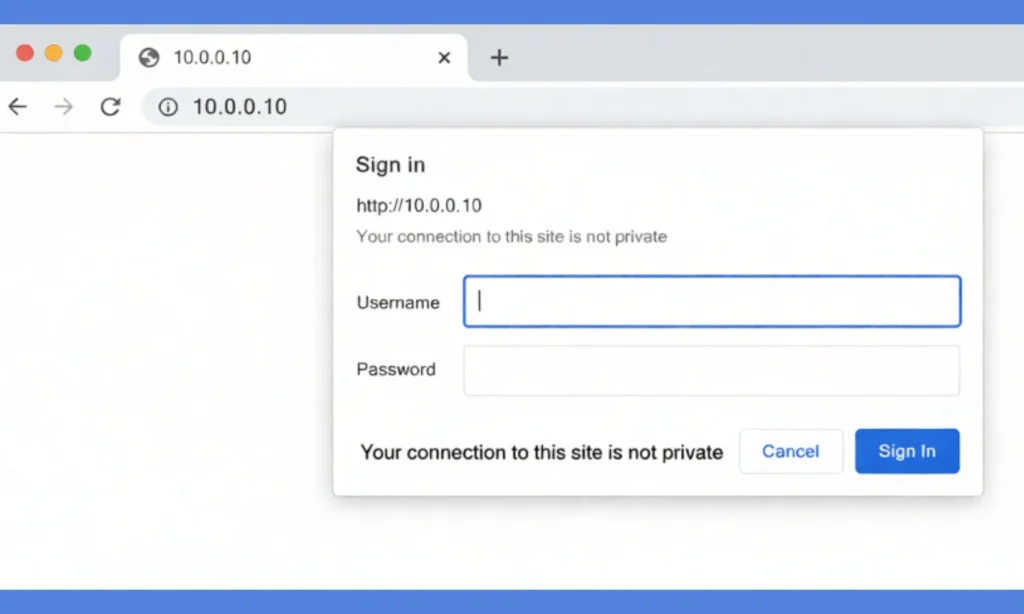
Enter the following address carefully in the address bar of a browser:
http://10.0.0.10
Press Enter.
4. Enter Login Credentials
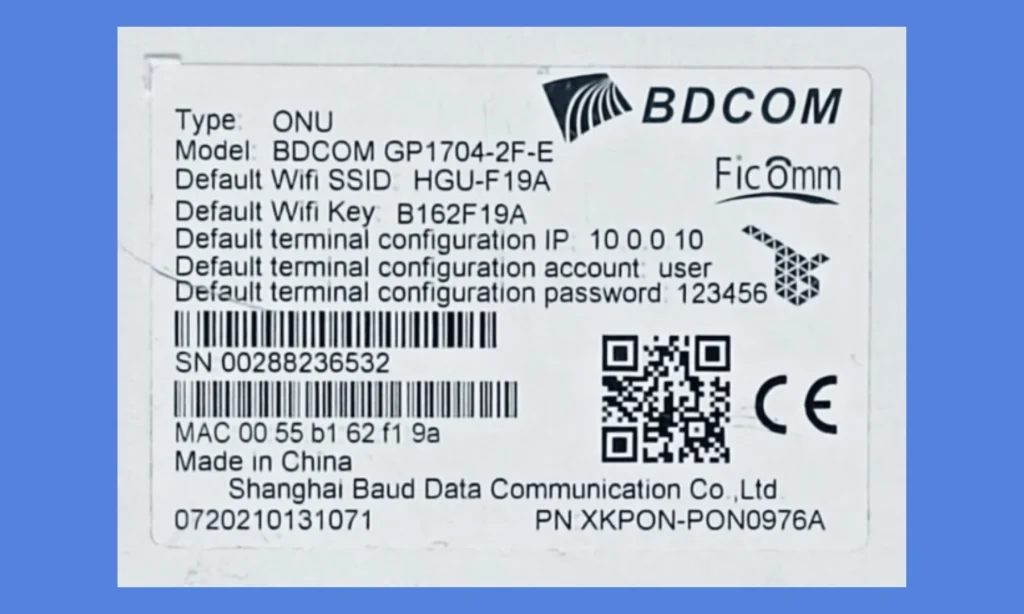
Upon loading the page that shows the login button, the default username and password should be entered automatically. They are usually printed on a label on the rear of your router or supplied by your ISP.
Typical default usernames and passwords are:
admin/admin
user/user
root/admin
If you have changed the credentials in the previous case, you can use your own username and password to log in to 10.0.0.10.
5. Access Admin Settings
Upon logging in, the administration dashboard is displayed. From here you can:
– modify the Wi-Fi name (SSID) and password.
– See connected devices
– Set security settings
– Time and access to Piso Wi-Fi.
– Update network preferences and firmware
– update the network preferences and firmware.
6. Save Changes
When changes have been made, make sure you always save or apply them to make them effective. Some routers can automatically restart to complete the update.
With proper precautions and the correct address 10.0.0.10, you can easily access your router or Piso Wi-Fi device using the correct address 10.0.0.10 rather than the wrong version 10.0.010 or 10.00.10.
Relevant IP Addresses:
It belongs to the same private IP range as 10.10.10.1.
Some Fiber modems might use this instead of 192.168.100.1.
If you are a PLDT user, your default is likely 192.168.1.1.
How to Change the WiFi Name and Password Using 10.0.0.10
- Access WiFi or Wireless Settings.
After completing the login process, search the menu for wireless, WiFi, or network settings. Locate the SSID field – your Wi-Fi name. Locate the Wi-Fi Password, Pre-Shared Key, or security Key.
- Change WiFi Name (SSID)
Enter a new, distinct Wi-Fi name you can easily remember. You should not use your personal information, such as your full name or address.
- Set a Strong WiFi Password
Choose a safe password that incorporates:
– Both lower and uppercase letters.
– Numbers
– Symbols
– At least 10–12 characters
This will ensure that your network is not hacked or used unauthorisedly via the 10.0.0.10 gateway.
- Save and Apply Changes
To enable the new settings, click Apply, Save, or Update. Your router can boot itself up.
- Reconnect All Devices
Once the changes have been made, reconnect all your devices to the new Wi-Fi name and password.
7.Dual‑Band WiFi (2.4 GHz and 5 GHz)
If your router also supports 2.4 and 5 GHz, you will have to change the SSID and password separately. You can:
– Use the same password and name with both bands, or
– Name the faster network by a different name for each band.
You can have a secure, smooth, and reliable network experience by using the 10.0.0.10 admin panel rather than typing 10.0.010 or 10.0.0.10.
10.0.0.10 Piso WiFi User Login Guide
Piso WiFi vending machines use the 10.0.0.10 login page. It allows the user to manage their web sessions.
1. Connect to the WiFi Network of Piso
Connect your cell phone, tablet, or laptop to the vending machine’s Piso WiFi hotspot.
2. Open a Web Browser
Launch any web browser, such as Chrome, Safari, Firefox, or Edge.
3. Enter the Correct IP Address
In the address bar, type:
http://10.0.0.10
or
http://10.0.0.10/admin
Press Enter. Do not use incorrect formats; use 10.0.0.10 or 10.0.0.10/admin.
4. Access the User Dashboard
Upon opening the page, the Piso WiFi homepage appears. From here, you can:
Enter voucher code
Coins should generate Access codes.
Watch the remaining internet time or balance.
5. Key in Voucher/Coin-Based Code
Based on system configuration:
There is the printed voucher code that the operator gives, or
Enter the access code provided after loading coins into the Piso WiFi machine.
Once you enter the code, your session will start and the timer will begin.
6. Manage Your Connection
Inside the user panel, you can:
- Follow up on remaining minutes or balance.
- Take a break to conserve wasted time.
- The Internet can always be accessed.
- Disconnect when finished
These alternatives allow users to manage their usage and prevent wasting credits.
Piso WiFi Pause Time in 10.0.0.10
What Is Piso WiFi Pause Time?
Pause Time allows you to pause your running session. The timer stops. At the point of resuming, the time remaining takes up the place it left. It works in breaks or minor interruptions.
Key Benefits of Pause Time
- Keeps balance and unused minutes.
- Free to have total control over your internet.
- Helps manage bandwidth during traffic.
- Protect your session against unauthorized access.
Safety Measures for Piso WiFi Operators
In the case of operators of the 10.0.0.10 admin panel:
- Click “Use a strong password” for the admin login.
- Admin URL should not be posted publicly.
- Keep firmware updated
- Test coin slots and voucher systems regularly.
A safe 10.0.0.10 is installed to enable hassle-free network operations and usage, and to keep the system secure and reliable.
You can also check the 192.168.8.1 router settings page if your device is using a different default IP.
Default Username and Password of 10.0.0.10 Admin login
To access the admin panel at 10.0.0.10, one must enter the proper credentials, i.e., Username and password. There are a lot of routers and Piso WiFi on 10.0.0.10 with default credentials.
Default passwords on 10.0.0.10 Routers
The table below represents a general reference table of common default usernames and passwords that are in use by devices depending on the 10.0.0.10 gateway:
Brand / Device | Username | Password |
Generic Router | admin | admin |
BDCOM | admin | admin |
TP-Link (select units) | admin | admin |
Huawei | admin | admin |
Cisco | admin | admin |
ZTE | admin | admin |
Piso WiFi Vendo | admin | 1234 |
PLDT / ISP Routers | admin | 12345678 |
Celeno Devices | none | none |
Custom Firmware Units | admin | password |
Note: Default credentials may vary depending on the router model, firmware version, ISP configuration, or custom setup. Always check your device label first.
What to Do If the 10.0.0.10 Login Details Don't Work
Double-check the sticker on the router or Piso WiFi machine
Try common combinations mentioned in the above table of default logins.
Clear your browser cache and reload the 10.0 0.10 login page
Restart the router and try again
Contact your ISP if the router was preconfigured
As a last option, reset the router to factory settings (only if permitted)
Where to Find the Correct Default Login Information
If you’re unsure which credentials apply to your device, check:
- The label on the back or bottom of the router
- The printed user manual or quick-start guide
- The official website of the router manufacturer
- ISP documentation (for provider-issued routers)
- The Piso WiFi vendo machine label
Common Errors and Mistyped Addresses for 10.0.0.10
Because 10.0.0.10 contains multiple zeros, it’s often mistyped. Even one small mistake will prevent the 10.0 0.10 login page from opening and may show error messages like “site can’t be reached” or timeouts.
Frequent Mistyped IP Addresses
Mistyped IP Address | Reason It’s Wrong | Correct Form |
10.0.10 | Missing a zero in the third octet | 10.0.0.10 |
10.0 010 / 10.0.0.010 | Extra zero added | 10.0.0.10 |
10.0.o.10 | The letter “o” is used instead of zero | 10.0.0.10 |
10.0.0.l0 | Lowercase “L” instead of zero | 10.0.0.10 |
100.0.0.10 | Too many digits in the first octet | 10.0.0.10 |
10,0,0,10 | Commas used instead of dots | 10.0.0.10 |
10.0.0.1 | Completely different IP address | 10.0.0.10 |
Resolving the Common 10.0.0.10 Access Problems
If the 10.0.0.10 login page doesn’t open or you cannot access the 10.0.0.10 admin panel, there is nothing to worry about! Such problems are typically caused by minor issues that can be solved. The typical causes include entering an incorrect IP address, network connection issues, browser cache, router glitches, or lost logins. The following is a detailed troubleshooting guide to help you resolve these issues as quickly as possible.If the login panel doesn’t load, check whether your router is configured to use the 192.168.18.1 admin login page instead.
1. Incorrect IP Address Entry
The most frequent problem is typing the incorrect IP address. Errors such as 10.0.10, 10.0.o.10, 10.0 010, or 10.0 0.0 10 will prevent the page from loading.
Solution:
They should always key in the right IP address:
http://10.0.0.10
Please be sure to use dots (.) in place of commas and use 0s (0) in place of letters.
2. Not a part of the right Network.
If you look at the 10.0.0.10 login page and it returns an error or does not load, you may not be connected to the Piso WiFi network or to the correct router.
Common mistakes include:
- Using mobile data
- Connection to another WiFi network.
- Using a hotspot
Solution:
Connect directly to the router’s WiFi or via an Ethernet cable. For Piso WiFi, click the correct Piso network, which has 10.0.0.10.
3. Browser Cache and Cookies Problems.
Even old cache files or cookies may prevent the 10.0.0.10 admin page from loading correctly.
Solution:
Refresh the page.
Clear the browser history and cookies.
attempt to open the page in a different browser (Chrome, Firefox, Edge, etc.).
The problem is usually solved immediately by changing browsers.
4. Router or System Glitches
There are cases when routers can overload temporarily or glitch away access to the administration panel.
Solution:
Restart the router.
Allow this to reboot fully (1020s).
Try reaccessing http://10.0.0.10.
A restart will wipe the router’s memory and, in most cases, fix the loading issue immediately.
5. Various Default Gateway IPs.
Not all routers have 10.0.0.10 as the default gateway. Some models use other IP addresses.
The most typical substitutes are:
- 10.0.0.1
- 192.168.1.1
- 192.168.0.1
Solution:
There is a default gateway that should be used by your router, and you need to check your device’s network settings to locate it. In case the router does not use 10.0.0.10, the page will fail to load.
6. Lost Username or Password
If you changed the default admin password and forgot it, you will not be able to access the 10.0.0.10 admin panel.
Solution:
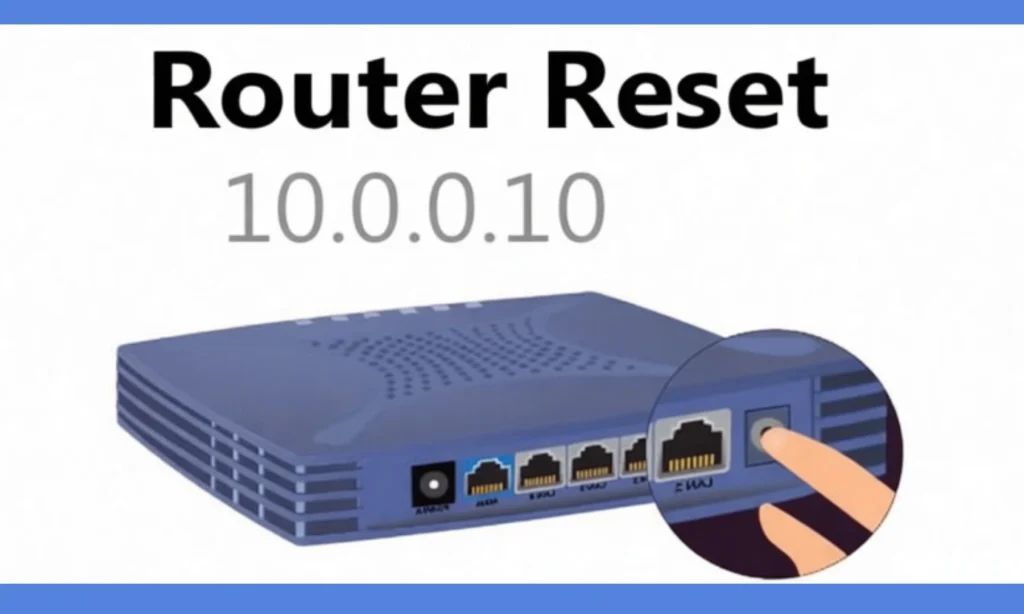
To perform a factory reset, press any reset button for 10 to 15 seconds.
This formats the router back to its default settings.
Log back in using the initial default username and password.
Logging into the 10.0.0.10 IP Address and Changing the Settings Using any Device
The 10.0.0.10 login page is accessible on practically any device, including computers, smartphones, and tablets. The process of logging in is similar as long as your device is connected to the router or Piso WiFi network. It is only that the browser and connection method can be varied. How to access your 10.0.0.10 admin panel on various platforms and update your network settings safely can be seen below.
Windows PC or Laptop
Connect your PC or laptop to the router via Wi-Fi or an Ethernet cable.
- Launch a web browser, e.g., Chrome, Edge, or Firefox.
- Enter the address bar with the following type: http://10.0.0.10 and press Enter.
- Depending on your system, enter your username and password.
- Go to the dashboard and update the Wi-Fi name, password, security, or any other settings.
Best practice: When making necessary settings changes with wired Ethernet, it is good practice to create a wired connection to avoid interruption.
macOS (MacBook or iMac)
Link your Mac to the router’s WiFi network.
- Open Safari or Chrome.
- Enter 10.0.0.10 in the address bar.
- Log in with the default or changed administrative account.
- Edit and either save or apply.
Best practice: If the page doesn’t load, clear your browser cache or try another browser.
Android Smartphone or Tablet.
- Connect the Android to the router’s Wi-Fi.
- Open Google Chrome or any other browser.
- Click the address bar, then tap Enter.
- Log in to the 10.0.0.10 admin panel.
- Change the WiFi name, passwords, bandwidth management, or security settings.
Best practice: Disable mobile data to stay on the Wi-Fi network in the browser.
iPhone or iPad (iOS Devices)
- Connect your iOS device to the router’s Wi-Fi network.
- Open Safari or Chrome.
- Type in the URL bar 10.0.0.10 and tap Go.
- Type in your administrative log-in.
- Individualize WiFi, device access, and security options.
Best practice: WiFi reconnection in case the page does not load.
Checking Your Actual Default Gateway
If you are not sure about the gateway of your router (10.0.0.10), you can verify it on your computer.
Device / Platform | Steps to Find the Default Gateway |
Windows | 1. Press Win + R 2. Type cmd and press Enter 3. Type ipconfig and press Enter 4. Look for Default Gateway |
Android / iPhone | 1. Open WiFi Settings 2. Tap the connected WiFi network 3. Check the Gateway or Router |
macOS | 1. Open System Settings 2. Go to Network 3. Select your WiFi network 4. Look under Router |
This will ascertain the correct IP of your network, 10.0.0.10.
How to Secure Your Network with 10.0.0.10
The 10.0.0.10 admin panel allows you complete control of your network, and as such, it is essential to secure it so that you can protect your data and prevent unauthorized access.
Essential security Tips
- Change the default username and the password to a strong, unique one.
- Activate WPA3 or WPA2 encryption for the wireless network.
- Block the suspicious or unknown connected devices.
- Turn off remote access when it is not necessary.
- Maintain the router software to fix bugs and security vulnerabilities.
- Take a copy of your router settings so that they can be easily restored.
FAQs
What is 10.0.0.10 used for?
10.0.0.10 is a private IP address used to open the admin or user panel of certain routers and Piso WiFi systems. It lets you manage WiFi settings, security options, and internet access.
How can I log in to 10.0.0.10?
Connect your device to the router’s WiFi or LAN cable, open any web browser, type http://10.0.0.10 in the address bar, and enter your admin username and password.
Why is 10.0.0.10 not opening on my browser?
This usually happens if the IP address is mistyped, your device is not connected to the router, or your router uses a different gateway address.
Is 10.0.0.10 the same as 10.0.0.1?
No, both are different private IP addresses. Routers use one specific gateway depending on their brand and configuration.
What should I do if I forget my router password?
You need to reset the router to factory settings. Press and hold the reset button for about 10–15 seconds, then log in again using the default credentials.
How does Piso WiFi Pause Time work on 10.0.0.10?
Open http://10.0.0.10, access the Piso WiFi user portal, and tap the Pause option. This stops your session temporarily and saves your remaining time so you can resume later.
FINAL IDEAS
192.168.100.1 is a straightforward yet powerful method to manage the router’s and Wi-Fi settings. By logging in, you can change your WiFi password, update your network name, boost security, and fix common connection problems.
Always use a strong password for both your Wi-Fi and user logins, and keep your router software updated to maintain speed and security.
The reset option allows you to start over if you ever lose your login information.
Anyone can take full ownership of their home or workplace network and benefit from a quicker, safer, and more reliable internet connection by following these steps.